Back to Top

Category: Bible Interpretation

What We DO Know When We Don’t Know

Everyone carries a circumstance they would undo if they could — the diagnosis, the estrangement, the door that closed, the prayer that has gone unanswered for years. In the previous passage, Paul admitted that we often don’t even know how to pray about such things: we can’t see what God is doing, so the Spirit intercedes for us in groanings that run deeper than words. But then Paul sets down the counterweight — the one thing we do know, and it is enough to steady a believer through the hardest providence: God is working all things together for good. What follows is a condensed look at Chapter 29 of Romans, Vol. 1: Justified.

We know that all things work together for the good of those who love God: those who are called according to His purpose. (Romans 8:28, HCSB)

Paul opens with “we know,” and it is the same word for knowing he used two verses earlier — “we do not know what to pray for as we should.” The repetition is deliberate. What we lack is the ability to see what God is specifically doing in a given moment. What we possess is the settled certainty of his character and purpose: whatever he is doing, it is for our good. The gap between what we cannot see and what we know is bridged by faith. Behind it stands the sovereignty of God — who is never surprised, never scrambling to recover from events that caught him off guard. What happens to the believer is not random. It is superintended.

“All things” is unqualified — not most things, not the manageable things. The election that doesn’t go as hoped, the diagnosis that comes back wrong, the job that disappears, the marriage that strains, the child who walks away, the thorn God refuses to remove — all of it. “Work together” is a single Greek word, synergeo (soo-ner-geh’-oh), “to co-labor.” It is a deliberate echo of the previous passage: the same Spirit who “joins to help” us when we don’t know how to pray is the one co-laboring through the outcomes those prayers produce. He is active not only at the point of prayer but at the point of result, working all of it in the direction of the believer’s good.

Notice carefully what the verse does not say. It does not say all things are good — plainly they are not. Genuinely terrible things happen to people who love God. The point is that they work together for good: God co-labors through them so that the outcome is our real benefit, even when the ingredients are painful. Paul’s own thorn is the clearest example. He asked three times for it to be removed, and God’s answer was not “yes” but something better — my grace is sufficient for you, for my power is perfected in weakness. The very thing Paul wanted gone was the instrument through which God was displaying his power. God’s assessment of what was good for Paul differed from Paul’s own — and God was right.

And the promise is not universal. It belongs to a specific people: “those who love God, those who are called according to his purpose.” The love in view is not sentiment that rises and falls with circumstances, but a settled, chosen love — anchored in who God is rather than in what he has provided, the love that persists precisely when the outcomes are hard. And the calling runs in one direction: God calls; we are the recipients. Because the believer’s security rests on his purpose rather than on our ability to manage our circumstances correctly, the outcome is sure. His purpose for those he has called is good — to conform them to the image of his Son — and so all things are always moving in that direction, whether we can perceive it or not.

We do not pray as we ought. But we know that all things work together for good. Those two clauses belong together — the first is the honest admission, the second is the ground we stand on when the first is true. Not always what we asked for. Not always what felt like it should happen. But good — genuinely, ultimately, sovereignly good, the way a loving father knows what is good for a child who cannot yet see it.

This is only a condensed look at a single chapter. In Romans, Vol. 1: Justified, the full treatment of Romans 8:28 traces every word of the text, follows the thread from the Spirit’s intercession into the “golden chain” of God’s purpose that comes next, and lingers over the pastoral weight of a promise this large. It’s one of thirty-five verse-by-verse chapters walking through Romans 1–8, written for pastors, teachers, and anyone who wants to study Paul’s masterwork with real depth — no seminary required. The research has already been done; what remains is for you to open the text and be fed by it. You can pick up your copy here:

When You Don’t Know How to Pray

Every believer has knelt to pray and felt the words run out. We know what we want — the diagnosis reversed, the marriage healed, the job kept — but we don’t always know what to ask for, because we can’t see what God is doing beneath the surface of our circumstances. Romans 8:26–27 speaks directly into that helplessness, and it may be one of the most comforting things Paul ever wrote. What follows is a condensed look at Chapter 28 of Romans, Vol. 1: Justified.

In the same way the Spirit also joins to help us in our weakness, because we do not know what to pray for as we should, but the Spirit Himself intercedes for us with unspoken groanings. And He who searches the hearts knows the Spirit’s mind-set, because He intercedes for the saints according to the will of God. (Romans 8:26–27, HCSB)

Paul has been describing groaning — creation groaning in its bondage to decay, and believers groaning within, waiting for the redemption of the body. “In the same way,” he says, the Spirit groans too. The phrase “joins to help” translates a single Greek compound, synantilambanomai (soon-an-tee-lam-ban’-oh-mahee), built from words meaning “with,” “opposite,” and “take.” The Spirit does not merely lend a hand over the last hurdle, as though we were nearly capable on our own. He takes the opposite position from our weakness entirely — supplying what we lack out of his own sufficiency. That is the Christian life in its most honest form: we are incapable, and the Spirit makes us capable.

Why do we need this help? Because “we do not know what to pray for as we should.” The word for “know” here is oida (ee’-doo) — not ginōskō (ghin-oce’-ko), the word for acquired, learned knowledge, but oida, the word for knowledge that is seen, knowledge that is intuitive and apparent from what is before one’s eyes.  Experiential knowledge. Paul isn’t saying we’re untrained in prayer. He’s saying we cannot see. We don’t have God’s vantage point. We pray for the sick without knowing whether healing or endurance better serves God’s purpose in that life. We pray for rescue when God may be sustaining us through the very thing we’re asking to escape. We pray for what we can see; God is working in what we cannot. This is why the most faith-filled prayer ever offered was Gethsemane’s “not my will, but yours be done” — not passive resignation, but recognition: You see what I cannot, and what You are doing is better than what I would ask for.

So the Spirit intercedes “with unspoken groanings.” The word for unspoken is alalētos (al-al’-ay-tos) — literally un-speakable, that which cannot be put into words. Some have used this verse to argue for a private prayer language, but the word refutes that reading: a prayer language is spoken, while alalētos means the exact opposite. These groanings belong to a communication between the Spirit and the Father that never passes through human language at all. And notice the pronoun — the Spirit Himself. This is not our spirit, and not a technique we perform. It is the third person of the Trinity praying for you.

And the Father receives it perfectly. He “who searches the hearts” knows the Spirit’s mind, because the Spirit intercedes “according to the will of God.” No translation is required; the communication is complete without a single word. Here is the communion of the Godhead working on your behalf — the Spirit praying, the Father knowing, the Son already seated at his right hand as your guarantee. The believer who groans in weakness and confusion, without the words to say what he needs, is being prayed for by God, to God, according to the perfect will of God.

That is the unseen engine behind the promise Paul is about to make (we’ll cover this soon, in the next post) — that God works all things together for the good of those who love him. God is not blind, not deaf, and not absent. He is interceding for you in ways you cannot hear, would not understand if you could hear, and cannot fail to receive because they are asked in accordance with what God is already doing through your life.

This is only a condensed glimpse of a single chapter. In Romans, Vol. 1: Justified, the full treatment of Romans 8:26–27 goes further still — tracing every word of the text, showing how the passage locks into the argument around it, and drawing out the pastoral comfort it offers for the moments when prayer feels impossible. It’s one of thirty-five verse-by-verse chapters walking through Romans 1–8, written for pastors, teachers, and anyone who wants to study Paul’s masterwork with real depth — no seminary required. The research has already been done; what remains is for you to open the text and be fed by it. You can pick up your copy here:

The Study Guide Series

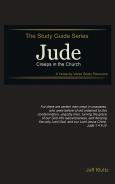
The new Study Guide Series is being developed as we speak.  Jude: Creeps in the Church has hit the Kindle shelf (a small, easy book to start with!) and will be released in paperback on June 1st at Amazon (Get It Here).  Next in the que is Romans Pt. 1, which is about halfway edited. 

(see all books here)


So what is this all about???

Every serious student of God’s word faces the same challenge. The resources exist — the commentaries, the lexicons, the word study tools, the historical backgrounds — and they are rich beyond measure. But they are also vast, technical, and often designed for the scholar rather than the teacher or student.  Hours of careful research regularly produce far more than any single lesson, sermon, or study can utilize. The discovery is rewarding. The distillation is exhausting. And the question that every pastor, lay teacher, or student eventually asks is the same: where is the resource that has already done this work — and done it well?

The Study Guide Series is a verse-by-verse teaching series designed to answer that question for every book of the Bible it covers. Each volume works through its text with careful attention to the original Hebrew and Greek, the historical and canonical context, the biblical backgrounds, and the flow of the argument from first verse to last — and presents all of it in a form that is immediately usable by anyone studying or called to teach the Word, regardless of their formal training. No prior language knowledge is required. No supplementary tools are necessary. The serious work of scholarship has been done and distilled into the twenty percent of the effort that actually makes it into the room where learning happens.

Whether you are a pastor preparing a sermon series, a small group leader working through a book of the Bible with your congregation, or a student of scripture who wants to go deeper without getting lost, The Study Guide Series gives you what you need — a reliable, thorough, accessible guide to the text in your hands, and the confidence that comes from knowing you have not merely skimmed the surface of what God has said.

(see all books here)

Loving Those We Dislike

[Originally published in The Fort Bend Herald]

 One of the most difficult concepts of Christianity involves a series of commands that relegate us to love pretty much everyone, everywhere and in every situation.  While the sentiment of that seems truly noble and altruistic, many find themselves in a very difficult crisis of faith for the simple fact that there are some people we honestly find very hard to like.  “Liking” involves commonality in thought or position.  It involves someone we consider compatible and worthy.  It involves reciprocity.  Indeed, all of us have those around us of whom these traits simply do not exist.  We simply do not “like” everyone.  How, then, are we to love them?

The first order is to confirm the need for such indiscriminating love in the scriptures.  Indeed, Jesus tells us to love our neighbor (Mt 22:39).  The apostles teach us to love one another in the church (Rom 12:10) and our spouses (Eph 5:25).  These emanations of love seem easy enough to fulfill; or at least a realistic goal to shoot at- until we realize that even these two commands come with caveats:  Jesus said to love our neighbors as ourselves, and Paul instructed husbands to love their wives as their own bodies.

But wait: it gets worse, for Jesus further said that we should love even our enemies! (Mat 5:43-44)  This instruction, he follows with, “For if you love those who love you… do not even the tax collectors do the same?” (v. 46)

Now the sentiment is getting downright troublesome.  Let’s face it, it’s hard at times to love even those people we share Thanksgiving Dinner with – let alone those who have earned the moniker of “enemy.”  For all practical purposes, the very definition of “an enemy” is someone that in the very least we do not like at all.  How, then, are we to love those we (sometimes for good reason) simply do not like?

The bad news is this is not an easy pursuit, even when properly understood.  The good news is most of us have completely misunderstood this set of commands because of language issues.

“Love,” in English is an extremely flexible term.  We love our spouses and we love our dog.  (Surely those two do not mean the same thing.)  We love certain forms of art.  We love chicken fried steak and we love our children.  Each of these things gets coined as “that which we love” but with significantly distinct meanings and inferences that actually separate this idea of “love” into numerous categorically different things altogether.

In the New Testament there are two different Greek terms translated into English as “love.” One term is the term most similar to that “love” we claim for our families and friends.  The other is a sense of the idea of “love” that frankly, we do not use very often in conversational English.  (There is no Greek equivalent to our love for chicken fried steak to my knowledge… that must be an English thing.)

The lesser used term for “love” in the NT (about 20 times) is phileo (phil-eh’-oh); often referred to as “brotherly love.”  Such is the namesake for the city of Philadelphia and various other English terms with the “phile” suffix.  This term is best understood as “relational” love.  It is that “I love you because you and I have a personal connection.”  This term best fits with our love of family and friends, because it is reciprocal: the love we have for those we “like.” Most of us are thinking of THIS type of love when we hear the command to “love your enemies.”  But, relax – that is not the command we have been given.

The second and far more common “love” in the NT (over 250 times) is agape (ah-gah’-pay) (n) or agapao (ah-ga-pah’-o) (v).  This is (potentially) unreciprocated love.  It is a love that is chosen, deliberate and service oriented; but not necessarily relational.  To love in this manner is tantamount to Jesus’ golden rule: to treat others as we wish to be treated.  This is the love we are administering when we give money to help feed or clothe total strangers.  It is the love we are sharing when we stop to help a stranger on the side of the road.  These are not reciprocal actions:  I’m not helping because I realized that was a friend of mine I just passed on the highway.  These are chosen, deliberate acts of service to others out of reverence for their creator and recognition of their need.

While both types of love are commanded in scripture in various scenarios, we are ten times more often commanded to agapao those around us: love through service and with potentially nothing gained in return.  THIS is the love we are commanded to give our enemies.   We are to value them as human beings and provide them with dignity and service when able.  We should help them when in need.  We should speak kindly and act compassionately even if they are our political enemies or are on the “other side” of the culture war.  It is this love that God demonstrated toward us in that he loved us while we were his enemies (Rom 5:8).  In the same manner, we are to love our enemies; even if we don’t happen to like them.

Why I Dropped my NIV for an ESV

On my 16th birthday I received, by request, a new Thompson Chain Reference NIV Bible.  As a 16 year old, I had no insights- nor did I consider the need of them- concerning the integrity of the NIV translation.  I simply knew that my new NIV Bible was easier to understand than the KJV I had used up to that point.

As it turns out, by God’s grace, the NIV I was ingesting was actually a pretty good translation overall.  It is a good “middling” of two interpretational extremes.  As a ministry student, which I became just a few years thereafter, one’s translation is never one’s only translation; it is simply the translation one preaches and teaches from.  It is the translation one commits to memory.  I spent over twenty five years doing just that with my (1984) NIV.  Continue Reading

The Seven Churches Pt. 3 – Ephesus, pt. A (video)

(This is a confinuation of “The Seven Churches” Vlog series on the churches of Revelation 1-3.  You may also want to watch other videos in this series to keep within context.)

  The first church John was asked to address of the seven was the church in Ephesus; a church which received both praise and rebuke from the Lord’s letter.

This week’s study focuses on the commendation to the church.  The rebuke will be dealt with in next week’s study.

Overwhelmingly, it is clear from the letter to the church at Ephesus that the faith entrusted to the saints is indeed something to be contended for: as the Lord himself gives his commendation to his church for not tolerating evil men and heresy.

The Seven Churches – Ephesus, pt. 1 from Jeff Kluttz on Vimeo.

The Seven Churches Pt. 2 – Introduction (Video)

(This is a confinuation of “The Seven Churches” Vlog series on the churches of Revelation 1-3.  You may also want to watch other videos in this series to keep within context.)

  While understanding the nature of the church age (as observed in last week’s session) is important to the interpretation of the letters to the seven churches, another very important interpretive principle is that of “context.”  This week’s video will examine the context of the book of Revelation, that the proper interpretation of the letters to the churches may be achieved, and the message of the letters may reach its intended mark: the church age at large.

The Seven Churches (Intro, pt 2) from Jeff Kluttz on Vimeo.

Interpreting the Bible 15 – Hebrew Poetry

(This is a continuation of the “Interpreting The Bible“ video blog series.  This post assumes the prerequisite watching of earlier videos in the series.  Click the link above to watch the entire series up to this week’s installment.)

 Unlike Western poetry, Hebrew poetry is not fashioned with rhythm and rhyme, but with a device known as parallelism.  Today’s study focuses on the nature of parallelism so that the biblical student may rightly divide poetic passages in scripture.

Bible Interpretation Pt. 15 – Hebrew Poetry from Jeff Kluttz on Vimeo.

The Seven Churches – Introduction (Video)

  Today begins a new study series on the Video Blog area of Returningking.com.  This series, currently being preached at First Baptist Church in Needville, TX, is an examination of the Seven Churches which the book of Revelation is written to in Asia Minor. 

The title of the series, however, is not “The Seven Churches of Asia Minor,” but rather “The Seven Churches,” because once one begins interpretational work on the book of Revelation it becomes clear that the seven churches do not only represent the seven historical churches whose names are written on the letter. Rather, these seven churches are seen throughout history, which is the context of the book of Revelation:

Revelation 1:19 (ESV)
19 Write therefore the things that you have seen, those that are and those that are to take place after this.

The Seven Churches (Intro, pt 1) from Jeff Kluttz on Vimeo.

Interpreting the Bible 14 – The Law of Recurrence

(This is a continuation of the “Interpreting The Bible“ video blog series.  This post assumes the prerequisite watching of earlier videos in the series.  Click the link above to watch the entire series up to this week’s installment.)

This week’s installation involves what is known as The Law of Recurrence.  This principle exists throughout the scriptures as an event narrated in two or more “passes.”  In such cases, frequently a story is told very generally, and then told again from the beginning but providing additional detail.

Not only is such recurrence very frequent in scripture, it is in fact the technique by which scripture begins itself in the account of creation.  Many have seen this particular instance of recurrence as an argument for two separate creation accounts.  Others have seen this recurrence as the very frequent literary device that it is: a story told in passes of varying detail and focus.

Today’s consideration of the law of recurrence includes a good deal of example from scripture to assist the interpreter in the understanding of the principle.

Bible Interpretation Pt. 14 from Jeff Kluttz on Vimeo.