Back to Top

Hidden Treasure

[Originally published in Fort Bend Herald]

 It seems we all have pursuits in our lives which honestly are of no measurable eternal consequence.  Simply put, we collect things that we perceive to enrich our lives in some tangible way, but that will most certainly be left behind for others to fight over when we depart from this Earth.  From the time of our first job a wish list is started of things that we will pursue and draw satisfaction from owning, using and maintaining; with the latter being the most difficult commitment of product ownership of all.

The fleeting nature of “stuff” has been recently illustrated to me through a classic Robalo boat.  I’ve been around boats all my life and from young adulthood have continually either pursued or endured boat ownership.  My current claim is a twenty five year old vessel that has truly surprised me with its quality, durability – and constant upkeep.

Being a salt water boat, rust is a constant enemy.  I recently acquired and rebuilt a trailer to haul the thing around at great expense of both finance and time invested.  That trailer has now been to the water three times and is already showing that faint, tell-tale sign of fresh rust on the springs, which I coated exceptionally well in a rust-blocking agent.  The clock is ticking.  I have three years before redoing the suspension.

If the trailer were the only maintenance concern I would probably gain two years of livelihood by the end.  But, the fact is that every single portion of this blessed mission of mine deteriorates with a vengeance.  Trailer lights are rewired every few years due to salt water infiltration destroying the copper wiring.  The exterior of the boat must be regularly deoxidized, waxed and repaired from sun damage, nicks and scrapes.  The gauges take turns in monthly increments giving up the ghost while the engine could write its own factory service manual at this point.  The simple fact is, I actually plan out – to the best of my entirely ignorant reckoning – what I expect to break next and how I will have the funding, time and knowledge to repair it when it does.  If I were not a bit of a masochist, actually enjoying my labors on this eternal project of a possession, I might be inclined to let her win quickly and just sink her to the bottom of the ocean.

It is no wonder to me that Jesus said, “Do not lay up for yourselves treasures on earth, where moth and rust destroy and where thieves break in and steal, but lay up for yourselves treasures in heaven, where neither moth nor rust destroys and where thieves do not break in and steal. For where your treasure is, there your heart will be also.” Matthew 6:19-21 (ESV)

There exist irreconcilable differences between every atom in this created universe and our own eternal nature and calling.  As it has wisely been stated, “you can’t take it with you,” we might also consider the question, “why would we want to?”  The scriptures teach us that we who are in Christ will one day be resurrected to new bodies, impervious to degradation or death.  We will be ushered into an eternal dwelling place likewise equipped with interminable wealth requiring no maintenance whatsoever.  Until then, Jesus informs us that we have the privilege of storing up true treasure for that day.

When the gospel is shared, eternal treasure is built.  When we serve others in Christ’s name, every hour spent yields countless benefit compared to beating our heads against our temporal projects.  How ironic that so often we find ourselves serving our Lord in ministry capacities only if we perceive ourselves “to have the time” from our pursuit of fretting over that which perishes.  May we rather pursue first that which is eternally rewarding, and only then “if we have time” turn our attention to that which we bother to hang onto for a little while. (Mat 6:33)  May our desires be to keep those things – and our true treasure – in their proper perspectives.  The stuff we can take with us is all that will matter on that day – even while others haggle over the remnants of our rotting possessions left behind.
Posted in Uncategorized |

What Kind of God?

[original article published in Fort Bend Herald, Sunday, February 24, 2013]

An age old question has found new life in recent debate concerning the seeming incongruity of an all-loving, all-powerful God being willing to bring the harshest of judgments upon his creation.  To be exact, the debate is generally kick started by some rendition of the question, “What kind of God would send people to an eternal judgment in Hell?”  The question is of course baited and the outcome presumed self-evident.  Supposedly one should nominate only a malevolent God as capable of such judgment.  Surely a loving God couldn’t be responsible for such harsh condemnation.

The answer tends to fall in one of several templated responses.  One group, believing the sentiment of the question, would say that in fact God does not send people to Hell at all.  Either Hell is an humanly-imposed product of the misinterpretation of Jesus’ (and the Old Testament Prophets, Apostles, church fathers, etc) words or in fact it is in some way a temporary sentence by which man can be properly refined, finding ultimate escape into eternal life.  Some believe in a form of annihilationism; that unbelievers will simply die without hope for Heaven, yet without judgment in Hell or any other punitive resort.  Some contend that God doesn’t ‘send’ anyone to Hell, but that men choose to go to Hell, as if they put their name in the wrong column of a sign-in sheet.  And some still hold to the classic Christian position that – in fact – we do serve the ‘kind of God’ who would sentence people to Hell and carry out such sentence first hand.

The question is only valid, of course, if in fact the scriptures claim that Hell is real and that God sends people there.  In the short space allotted, it can be quickly noted from the words of Christ himself that such is true.  Jesus’ account of his return and judgment speaks of the fate of the sinful in these terms: “(The King) will say to those on his left, ‘Depart from me, you who are cursed, into the eternal fire prepared for the devil and his angels.’” (Matthew 25:40-41)  Jesus affirms this position also in Matthew 10 and 23, along with numerous other references, yet from this text alone three things can be clearly seen: First, that Jesus proclaims a literal judgment of fire, second, that this judgment is eternal and third, that the King himself issues the sentence.  Other New Testament authors concur in clear language, such as Paul’s note in 2 Thes. 1:8-9, “He will punish those who do not know God and do not obey the gospel of our Lord Jesus.  They will be punished with everlasting destruction….” Thus, according to the scriptures, the question is valid: Just what kind of God would sentence people to Hell?

The question is actually answered clearly in the earlier portion of the 2 Thes. text above.  Verses 6-7 note, “God considers it just to repay with affliction… those who do not do not obey the gospel of our Lord Jesus.”  Romans 3 concurs, noting that until Christ took the full weight of the guilt of sin for the believer upon himself that in God’s forbearance “he had passed over former sins.  It was to show his righteousness at the present time, so that he might be just and the justifier of the one who has faith in Jesus.” (v25-26)

Rarely does one question a judge who sentences a child molester to a life sentence in prison.  We consider the penalty of such sin justly carried out by the utter segregation of the offender for the duration of his life.  What kind of judge issues such a sentence?  A just one – who upholds the law and considers the crime truly reprehensible.  No further examination need be sought out for God’s upholding of his sentence for sin.  He is just.  He hates sin.  He will satisfy its sentence.

Thanks be to God that He is in fact also a loving and forgiving God.  In Christ he has taken out his full retribution on sin for those who trust Christ alone as their sacrifice of atonement.  But he remains yet just.  Every man’s sins will be punished: either through Christ or the sinner himself.

Posted in Miscellaneous, sin, the gospel |

Quick to Listen – Slow to Tweet

Relationships once developed slowly via personal encounter.  Every chance meeting and handshake provided another casual conversation that gradually vetted the acceptable parameters of agreement on issues important to the two parties of a budding friendship.  To the degree that two people found familiarity and commonality a friendship developed.  Contrarily, when dissonance in virtue and ideology was uncovered a certain calculated distance was programmed into the relationship and the two parties silently negotiated an acceptable barrier for future encounters.  At the end of such process, legitimate friendship was the result of natural commonality between two people.  “Friends” were those who were generally in agreement with one another in areas considered important or desirable.

How profoundly certain things have changed in the social networking generation we now enjoy.  Becoming “friends” is in theory as simple as clicking a button on a Facebook profile screen of someone who perhaps has been never actually seen with the human eye of the friender.  Unlike the former process of methodically screening potential relationships through calculated conversation, now a person’s life story, political and social ideologies and a full array of revealing conversation with others is instantly displayed, organized and ingested in a single sitting.  Gone completely is the discipline once required to garnish such privileged information.

In this setting our lives are on display to a much wider audience than many seem to realize.  Things once said between friends with a wink of the eye are now heralded well beyond the privy of those who may have understood the sentiment of an inside anecdote.  The concept of an ‘inner circle’ simply does not exist in online form.  That which is posted on a social network is literally enshrined forever for public scrutiny.

The warning of James 1:19 must be seriously calulated more today than ever before: “let every person be quick to hear, slow to speak and slow to anger.”

It seems that every week I see some exceptionally awkward situation being aired in full living color on someone’s Facebook wall.  Personal disagreements are publicly posted in shameless attempt to illicit sympathy over issues which, if only left alone, would resolve themselvesg.  Yet, “quick to anger” translates to “quick to tweet” in our current social paradigm.  The frustration of the moment coupled with instant internet access persuades people to speak before they think and lash out before they listen.  The friendships of yesterday provided a built-in buffer from such rash behavior.  We went home, had a warm evening in the safety of family, slept on it and only then was the outside world encountered once again.

I was once told after a particularly frustrating conversation to write a letter to the person who had offended me stating everything I truly wanted to say.  Then, I was instructed to fold it up and read it again in twenty four hours and send it only if I still felt the same way.  Surprisingly to me, after twenty four hours I no longer wanted to say most of what I had written.  I threw the letter away in the end, and no damage was done to an important friendship.  What I practiced that day was the art of being “quick to hear, slow to speak and slow to anger.”

I would propose that any social networking post involving personal grievance be left alone entirely.  Yet, if you simply must write something, rather than posting it to the entire world why not email it to yourself, have dinner, hug your kids, sleep on it and then read it again tomorrow.  If it really needs to be said it will still need to be said tomorrow.  Let us practice being quick to listen and “slow to tweet” that our own sin of anger be not what is actually on display when we next click the ‘submit’ button and reveal our condition to all.

Posted in Miscellaneous, sin, Tidbits |

Are You Good Enough?

For as long as I can remember there has been a silent cultural message that “if you’re good enough” God will accept you as his own and secure you a permanent place at his side in eternity.  From Country and Western songs to Hallmark movie nights we are captured by the idea of a person realizing the error of their ways and making amends to a new status of a life well-lived.  This trend has been exacerbated in recent years by a multitude of teachers and preachers in the church who are attempting to remodel Christ as a life coach who desires to lead man to his true potential.  Turning from the old “you’re a sinner headed for judgment” model of reaching the masses, the new sentiment is “get on the wagon with Jesus and become something wonderful.”  I have to admit it has a nice ring.  It’s the stuff that after school specials were made for; grabbing oneself by the bootstraps and initiating the full potential of the human spirit in order to overcome the strongholds of one’s past.  Such stories are inspiring, entertaining and motivating.  After all, who among us could throw a stone at someone filled with good works, kindness and sacrificial service to others?  Indeed, these are the very characteristics that Jesus modeled and are the substance of the inner working of the Holy Spirit in the life of his chosen.

Such ideas represent the heart and soul of a moralistic gospel approach.  The model is simple: “Work hard, do better and God will accept you.”  And, the presumed merit of such good works is that they will somehow erase the stain of a former life that was decidedly “not good enough” in God’s eyes.  But will they really?

Several years ago I saw a news story on television about a woman who was discovered just miles down the road from where I lived.  The woman had been missing for many years.  She was not missing in the sense that she was lost, but in the sense that she did not want to be found.  This woman was an upstanding member of a nearby town.  She worked hard, had built a respectable life and was highly regarded by everyone who knew her.  She was active in her church and local schools and was known as a model citizen.  Yet, she had lived many years under an assumed name for fear of her past.  In fact, she had been convicted of horrible crimes at a younger age and had somehow escaped the custody of the state in order to assume a “new” life and identity as the person she wished she had been all along.  She had truly changed her ways.  Likened to the gospel of moralism, one might consider that she had erased her former sins by her current good life.

When this woman was discovered by authorities the television news became hyperactive about her story.  Some argued that she had lived a good and respectable life in the time since her heinous crimes and should be allowed to continue her new-found “good life.”  Others argued that this woman could not possibly have been guilty of the crimes that she had been convicted of, for she had proven her mettle publicly for so many years.  But, at the end of all such sentiment there was one thing that stood resolutely in the way of her freedom: the law.

The issue this woman had was not her inability to do well by her community.  Her issue was not that she was unfit to exist among the other humans in harmony.  It was not that she lacked the potential to fit in, be nice, get along with others or that she had failed to do any sufficient good works as deemed proper by the community.  Her issue was that she had resolutely broken the law in a major way and had been sentenced to punitive discipline by the law.  It frankly did not matter how good of a life she had lived the past number of years or how many people she had helped.  Her punishment was indifferent to her good works.  This woman had been formerly convicted of murder.  She owed a debt to society that could not be paid by simply “doing better from now on.”

This story illustrates perfectly the issue of a moralistic gospel.  The scripture says in Romans 3:23 that “all have sinned and fall short of the glory of God.”  You’ll notice the accusation clearly: “all have sinned.” The problem man has with God is not that “you have not been good enough.”  The issue is that “you have sinned.”

Sin is a specific crime with a prescribed penalty announced from the very beginning of time: “the day you eat of it you will surely die.”  The penalty for sin is reaffirmed throughout the scriptures, being clearly shown again in Romans 6:23, “for the wages of sin is death, but the free gift of God is eternal life in Christ Jesus our Lord.” In short, our crime of sin is so substantial to God that we have been prescribed the death penalty for it.  We can attempt to hide, rebrand our life and/or gain the sentimental approval of everyone around us, but we will never get away from the perfect law that condemns us as sinners. Our penalty will be paid– either by us or by a gracious intercessor.

Friends, the gospel message has never been that God loved you so much he sent Jesus to earth to show you how to live better.  The gospel message is- and always has been- that God loved you so much he sent his innocent Son to earth to die for your sins and pay the sentence that you owe.

Because it is our sin – our offense of the law – that condemns us before God, there is simply no manner of good works that we can live up to that will ever save us.  There is no statute of limitations on sin.  It is a crime punishable by an eternal sentence that must – and will – be paid.

The good works performed by we who are in Christ are symptomatic of our salvation, but can never be the substance of it.  Our issue before God is not a lack of good works.  It is our offense of sin.  For that reason alone, you will never be good enough.  Rather, trust Christ’s provision of atonement on your behalf to save you from the wages of your sin and you will be transformed to the worthy and “good enough” creation you need to be.

Right Questions Wrongly Answered

(Editorial Note:  This article was written prior to Sunday’s shooting in Wisconsin.  Originally published in the Fort Bend Herald, July 29, 2012.  Minor edits have been inserted for this venue and date)

While the escalation of mass homicide in recent years is truly disturbing, perhaps equally ominous is our nation’s continued denial concerning the origination of such evil.  Reminiscent of Fort Hood, Columbine and Virginia Tech, the recent shootings in Aurora have once again stirred the country to evaluation regarding the cause of such seemingly disconnected and horrific acts.  Within hours of the incident commentators were politicizing the situation with appeals for better mental health care, gun control or public education.  One analyst confidently prophesied that, “our country has failed James Holmes” (the shooter) in some unexplained manner.

While a number of theoretical culprits may have been contributing factors to Holmes’ rampage, what is troubling about such responses is that they are built upon two false assumptions.  Foremost is the notion that such raw degeneracy is impossible in rational man except for some external influence.  Related and secondary is the presumption that proper human initiative can cure such deviation.  Mankind is deemed too equitable for such a heinous deed, thus something else must be ultimately liable.  Thus, Adam blames Eve while she points at a snake.  Responsibility is imagined outside of the offender’s control.

The scriptures are far less diplomatic of human propensity; asserting that all men possess a congenital sin disorder for which they are held responsible.  No one has to teach a two year old how to hit a friend in defiance.  Every toddler instinctively knows to lie about the half-eaten cookie.  Sin is innate from birth; albeit in ways that seem innocuous when displayed from the least defiled among us.  While even minor sin condemns us as guilty before a righteous judge, sin has a tendency to grow and mature into something far less cute than an unruly toddler’s tantrum.  Romans 1 teaches that men who reject and suppress God’s truths are given over by God to a continued descent into unquenchable depravity.  Verse 28 notes, “since they did not see fit to acknowledge God, God gave them up to a debased mind to do what ought not to be done.” Verse 30 affirms a further deterioration in that they become “haters of God, insolent, haughty, boastful, inventors of evil…faithless, heartless, ruthless.”

To those who affirm the trustworthiness of scripture, actions such as those taken by James Holmes are not enigmatic.  While surely he is troubled and debased beyond the normative societal rule, his issue remains the same as is common to all.  He is guilty of living out the fruition of an uncontrolled sin nature; the epitome of which is self-servitude to the exclusion of God’s supreme rule of law.  Our most obvious examples of the destruction of sin are played out in the lives of those likened to Holmes.

More appropriate than a clamor to lawmakers in light of this sort of wickedness is a resolute commitment to the restoration of sinners through the gospel of Jesus Christ.  The law of both God and man quite staunchly condemned the behavior of last Friday’s murderous rage before it ever happened.  At issue is not the lack of a clear legal standard, but a rebellious soul that considered himself exclusive to it.

Christ was crucified for such sin.  He paid sin’s eternal penalty for those who trust Him alone as their reparation before God.  Those who reject His provision will continue their slide toward obstinacy to unknown depths of depravity.  Those who trust in Christ’s provision receive capacity to overcome sin in their lives, along with its eternal consequences.

Pray, therefore, for the propagation of the gospel in our increasingly wicked world.  Therein lies hope for depravity.

Posted in Miscellaneous, Political, sin, the gospel | Tagged , |

Fighting ‘Bigotry’ with Bigotry

The American system of public discourse and representative government is not hard to grasp.  We are “the melting pot” where people from every race, creed and background are welcomed to bring their best to the table.  Governing that table are representatives duly elected to uphold the will of the collective population from within the framework of an overshadowing constitutional standard.  From within that standard these representatives are charged with the task of establishing the law of the people, by the people and for the people.

In such a system several things are inherently necessary.  Among them is that the people have a voice and the freedom do express it fully.   Without such a voice, representatives govern without direction and pursue their personalized visions for the country.  Ability to express our collective voices has been assured in the First Amendment and in just about every state by written mandate.  After all, every seat of local, state and federal governments in our nation is democratically elected and representative in nature.  People simply must be allowed to express their political opinions for such a system to work.

At issue in the nation today is the variance between the mandate and the actions of our elected officials.  Case in point is the rash of recent government sponsored blockades of free speech as it relates to the hot-button “redefinition of marriage” mayhem.  In the past few weeks this has taken a very personal and utterly un-American turn as one of the nation’s largest family owned businesses is being targeted for extinction by government representatives-turned-operatives over the family’s constitutionally protected exercise of expressing their political opinions openly.

Dan Cathy, President and CEO of Chick-fil-A, apparently crossed an invisible line in the spirit of the First Amendment last week when he simply stated, “guilty as charged” to the assertion that he upholds a biblical definition of marriage (as being uniquely between man and woman).  He followed with comments on the Ken Coleman Show with his suggestion that the nation could face God’s judgment over the redefinition of marriage.  This, according to a growing list governing officials, is tantamount to gay bashing.

Chicago mayor Rahm Emanuel claimed that “Chick-fil-A values…disrespect our fellow neighbors and residents.”  He vowed to support the blocking of new Chick-fil-A construction announced by Proco Joe Moreno, in Chicago’s 1st Ward.  Moreno claims that Cathy is “bigoted” and “homophobic” because he is against gay marriage.  In addition to Chicago (the last place on earth that should be dis-allowing a successful business opportunity) Boston Mayor Thomas Menino informed the Boston Herald that he no longer wants Chick-fil-A in Boston.  In Mountain View, California a gay couple as at least temporarily blocked the opening of another Chick-fil-A by launching a “zoning” challenge, noting that “because it was a bunch of bigots, it gave us an extra nudge” to attempt to prevent them from building a restaurant there.

The irony of each of these scenarios should be crystal clear to anyone; whether gay, straight, atheistic or a believer.  Simply put, this is a full living color illustration of the new art of bullying via charges of ‘bigotry.’  Call someone a bigot and you will immediately find support for your cause.

Forget the fact the homosexual community is the first to scream “First Amendment” when they break decency laws on the streets of New York City; sodomizing one another in the streets for what is depicted as a “parade.”  Forget the fact that every group that has the ability to decry “bigot” does so with the same constitutionally granted freedom that those they cry against are using in stating their own objections.  Let’s focus on a much simpler fact:  gay marriage is a moral and POLITICAL issue being argued in every federal, state and local election bid.  Cathy did not say he hated homosexuals.  He did not say they were not allowed to eat in his establishments.  Quite the contrary, he noted the continued openness of his venues to serve people of all types, explicitly including “sexual orientation.”  The issue against Cathy is not homophobia or gay bashing.  Nothing of the sort has taken place.  He said what nearly every republican presidential nominee this past year has said; that he is opposed to the redefinition of marriage to include same-sex genders.

Since when has power been granted to government heads to punish their people for not “thinking” according to a pre-set template?  By what right does a mayor or a district alderman (for crying out loud) refuse successful businessmen from building their enterprise based on their being on the side of other government officials who argue the same principles?  Have these people not watched a single presidential debate this year?  Do they not read newspapers?  Are they so out of touch as to not know that this is an ongoing national debate?  This is America; a land built on the principle of public and open debate on the issues before the people.

Cathy is an American citizen.  His family employs 61,000 Americans in the worst economy of most of our lifetimes.  He has constitutionally-protected rights to express his opinion on any political issue of his choosing.  Any politician who attempts to destroy his business because of his views on a very public and torn political argument is proving himself to be a bigger bigot than he claims Cathy is.

Merriam-Webster defines bigotry as “a person who is obstinately or intolerantly devoted to his or her own opinions and prejudices…”  How more intolerant can one be than to determine “if you do not agree with our side of an ongoing national debate we will deny you a right to do business in our city?”  These men should be impeached for using their offices as playpens for their personal agendas.  They are clearly outside of their governing roles in a representative system when they harass their opponents over the fundamental practice of their rights.  They are doing precisely what they accuse others of doing by fighting (supposed) bigotry with bigotry.

Posted in Miscellaneous, Political | Tagged , |

Apostasy! is Released (New Book)

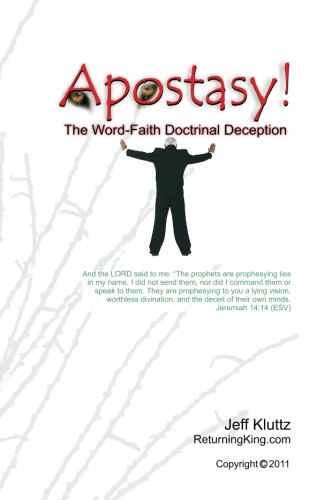
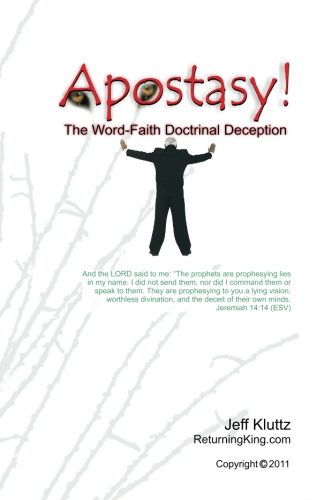
Apostasy! The Word-Faith Doctrinal Deception is released today on Amazon.com in print and Kindle editions.

Apostasy! is the result of several years of research and teaching concerning the doctrinal heritage of the Word of Faith movement. Numerous churches are finding themselves dealing with doctrines that have no biblical basis. They are, instead, the product of carefully corroborated and systematized “new” doctrinal distinctions that are aimed at the financial empowerment of the teachers of this movement.
cover
Many believers are hearing such doctrines from their church pulpits without awareness of their sources.
This book seeks to track the origination of these add-on doctrines and to reveal how their acceptance will alter systematic theology. Poor doctrines do not merely stick to the roof where they are preached: they infiltrate every dependent area of theology and create a truly heretical off-shoot of the historic Christian faith.
The Word of Faith, at its full fruition, teaches that God is not the all-powerful creator in his own accord, Jesus did not come to Earth as God incarnate, salvation was purchased in the Lake of Fire rather than on a cross, and that God can be forced to give man anything he commands. Sixteen chapters will reveal these, and many other exceptional errors in the movement’s dogma, each demonstrated by documented and footnoted quotes of the most famous of the Word-Faith teachers.
If you have found yourself scratching your head as to the origins of some of these “new” doctrinal positions, this book will lead you to their sources and the biblical rebuttal.
Available soon at other major retailers, Google books and E-books.
See all books from the author here.

Apostasy! The Word-Faith Doctrinal Deception (Released Soon)

On (or around) January 20, 2012, the upcoming book by author Jeff Kluttz, Apostasy!, will be released. This work is an examination of the men and women who have propagated the “Word Faith” doctrinal position that has so aggressively taken root in many of today’s charismatic churches. Many who serve the Lord in these churches are utterly unaware as to the sources of the doctrines they are hearing espoused from their local church pulpits. This work traces the sources of such doctrines as well as the new systematic theology which it naturally produces.
Error gives birth to error.  If a foundational tenet of a group’s doctrine is compromised, necessarily all following dogma will follow suit.  The Word-Faith premise is dangerous, flawed and unbiblical- even by the testimony of its teachers.

RELEASE:

Apostasy is creeping into the church from televisions, books and star-personality tours of rich and blasphemous self-proclaimed prophets of God; many of whom are the most famous pastors and teachers in the U.S.  These counterfeit shepherds teach that faith is a material substance more powerful than God, accessible to all men, and capable of creating anything man’s heart can desire by the mere utterance of faith-filled-words.  This doctrine has leached into all areas of the theological systems of what are known as “Word of Faith” churches.  Virtually every major area of systematic theology in this movement has been taken captive by the repercussions of this primordial error.

In this heresy, God is limited. Man is unlimited. Satan fills a necessary role in atonement for sin. Health, wealth, power and all means of temptation are heralded as virtues of the faith while millions empty their bank accounts for the promise of such ambition.

Preying on the poor and desperate, this movement is systematically fulfilling biblical prophesies concerning a latter-day apostasy within Christendom.
The book will be available here, at Returningking.com, or at the Author’s Amazon.com Page, once available to the public.

“The Storefront Saints Show” “Apostasy!” Interview

I was priviledged to have an extensive interview with Pastor David Catoe and Jeff Lege of Fresh Spring Baptist Church in Angleton, Texas concerning my upcoming book, Apostasy! on “The Storefront Saints Show.”

Apostasy!, which will be released soon, is a book concerning the turning from the true faith of the Word of Faith community.  This book is aimed at people who are involved in the Word of Faith, yet know that something is wrong with what they are hearing from such pulpits.  It is my hope that tonight’s interview will give a very brief introduction to the book for those who have been patiently awaiting its release.

Direct Link: http://www.ustream.tv/recorded/18633140

(Video begins after about 20 seconds of opening graphic) (You must hit “play” after advertisement)

Yom Kippur: A Reason for Christians to Celebrate

Yes, you read the title correctly.  To many, Yom Kippur is merely a foreign word that appears on our Outlook calendar each year.  It seems that most believers do not even know what it is, where it came from or most certainly what it represents.  Yom Kippur is a good reminder of just how much rich heritage of the faith gets lost for modern Gentile believers.  Because we do not serve the Mosaic requirements for Holy Days each year, we miss the richness of the Old Testament Feasts; each of which point to and are fulfilled by our Messiah, Jesus, in some way.

Yom Kippur, or The Day of Atonement in English, falls each Hebrew calendar year on the 10th of Tishrei.  The 10th of Tishrei this year, on our Western calendar, is tomorrow, October 8, 2011.  The celebration of Yom Kippur, for Jews, begins at sundown tonight. Continue Reading

Posted in Miscellaneous | Tagged , , |