Back to Top

Yearly Archives: 2010

The Spirit World (book): Free to ReturningKing.com readers!

We’re giving away The Spirit World book to ReturningKing.com readers!
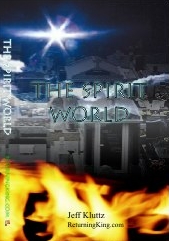
image The Spirit World is a study of the afterlife in scripture.  Far from simply referring to “Heaven and Hell,” the scripture reveals an assortment of containers which temporarily sort the souls of men and angels prior to the eternal state.  Places such as Sheol, Abaddon, and the Abyss are commonly used interchangeably by well-intended teachers of scripture.  Yet, scripture itself does not use these terms interchangeably at all; for each has a unique characteristic among the others.

The Spirit World provides a thorough examination of these terms and others, while time lining the course of human and angelic history from creation to the eternal state.  Additionally, The Spirit World will examine the nature of the judgments of the righteous and the wicked, as these actions are the trigger events which relegate men from the temporary to the eternal abodes.

Continue Reading

The Spirit World: Chapter One (Sheol)

Sheol 

(This is a continuation of The Spirit World book series. This post assumes the prerequisite reading of earlier posts in the series.)

Giving consideration to the fact that the Bible is translated from the Hebrew and Greek languages (with some Aramaic), it is necessary to evaluate original language terms to have a consistent understanding of the meanings of the English terms which represent them in translation.  One of the first terms one encounters in the scriptures which refers to a hidden spiritual realm is the Hebrew term, Sheol.  Being Hebrew, Sheol is found, of course, in the Old Testament.  Sheol literally means “the grave” or “the world of the dead.”  It is frequently translated into English as “the grave” and at times, “Hell,” although “Hell” is not the best translation for modern English consumption as will be explained in chapter eight. Continue Reading

Why I Dropped my NIV for an ESV

On my 16th birthday I received, by request, a new Thompson Chain Reference NIV Bible.  As a 16 year old, I had no insights- nor did I consider the need of them- concerning the integrity of the NIV translation.  I simply knew that my new NIV Bible was easier to understand than the KJV I had used up to that point.

As it turns out, by God’s grace, the NIV I was ingesting was actually a pretty good translation overall.  It is a good “middling” of two interpretational extremes.  As a ministry student, which I became just a few years thereafter, one’s translation is never one’s only translation; it is simply the translation one preaches and teaches from.  It is the translation one commits to memory.  I spent over twenty five years doing just that with my (1984) NIV.  Continue Reading

The Seven Churches Pt. 3 – Ephesus, pt. A (video)

(This is a confinuation of “The Seven Churches” Vlog series on the churches of Revelation 1-3.  You may also want to watch other videos in this series to keep within context.)

  The first church John was asked to address of the seven was the church in Ephesus; a church which received both praise and rebuke from the Lord’s letter.

This week’s study focuses on the commendation to the church.  The rebuke will be dealt with in next week’s study.

Overwhelmingly, it is clear from the letter to the church at Ephesus that the faith entrusted to the saints is indeed something to be contended for: as the Lord himself gives his commendation to his church for not tolerating evil men and heresy.

The Seven Churches – Ephesus, pt. 1 from Jeff Kluttz on Vimeo.

The Seven Churches Pt. 2 – Introduction (Video)

(This is a confinuation of “The Seven Churches” Vlog series on the churches of Revelation 1-3.  You may also want to watch other videos in this series to keep within context.)

  While understanding the nature of the church age (as observed in last week’s session) is important to the interpretation of the letters to the seven churches, another very important interpretive principle is that of “context.”  This week’s video will examine the context of the book of Revelation, that the proper interpretation of the letters to the churches may be achieved, and the message of the letters may reach its intended mark: the church age at large.

The Seven Churches (Intro, pt 2) from Jeff Kluttz on Vimeo.

Interpreting the Bible 15 – Hebrew Poetry

(This is a continuation of the “Interpreting The Bible“ video blog series.  This post assumes the prerequisite watching of earlier videos in the series.  Click the link above to watch the entire series up to this week’s installment.)

 Unlike Western poetry, Hebrew poetry is not fashioned with rhythm and rhyme, but with a device known as parallelism.  Today’s study focuses on the nature of parallelism so that the biblical student may rightly divide poetic passages in scripture.

Bible Interpretation Pt. 15 – Hebrew Poetry from Jeff Kluttz on Vimeo.

The Seven Churches – Introduction (Video)

  Today begins a new study series on the Video Blog area of Returningking.com.  This series, currently being preached at First Baptist Church in Needville, TX, is an examination of the Seven Churches which the book of Revelation is written to in Asia Minor. 

The title of the series, however, is not “The Seven Churches of Asia Minor,” but rather “The Seven Churches,” because once one begins interpretational work on the book of Revelation it becomes clear that the seven churches do not only represent the seven historical churches whose names are written on the letter. Rather, these seven churches are seen throughout history, which is the context of the book of Revelation:

Revelation 1:19 (ESV)
19 Write therefore the things that you have seen, those that are and those that are to take place after this.

The Seven Churches (Intro, pt 1) from Jeff Kluttz on Vimeo.

Deeds not Creeds: The Anti-Doctrine Doctrine

A new variety of church-growth movement is squarely upon us.  It decisively attempts to illegitimize any attempt at “doctrinal wall-building” for fear of excluding those frankly, who are unwilling to believe.  This sentiment has found itself at home in an increasing number of churches in recent years; being a boon to church growth (numerically) by removing those pesky doctrinal encumbrances which often cause people to seek membership elsewhere.

“Our very survival is at stake,” we are told.  The church, it is suggested, is to be about “tearing down walls” rather than building them; having entered into a “new” church-age whereby we focus attention copiously on harmony with others rather than differences.  Commonalities draw us together.  Differences divide us.  The church is to be a place of unity, fellowship and cohesion.  Anything that combats such a state of unanimity is quickly expelled as discordant, contentious and sinful.  (Sadly, about the only “sin” that can be agreed upon in our modern user-friendly church culture is that of being disruptive to the alliance of “group sentiment.”)  Such division, of course, is seen as a direct path to the most horrific sin of all: exclusivism. Continue Reading

Interpreting the Bible 14 – The Law of Recurrence

(This is a continuation of the “Interpreting The Bible“ video blog series.  This post assumes the prerequisite watching of earlier videos in the series.  Click the link above to watch the entire series up to this week’s installment.)

This week’s installation involves what is known as The Law of Recurrence.  This principle exists throughout the scriptures as an event narrated in two or more “passes.”  In such cases, frequently a story is told very generally, and then told again from the beginning but providing additional detail.

Not only is such recurrence very frequent in scripture, it is in fact the technique by which scripture begins itself in the account of creation.  Many have seen this particular instance of recurrence as an argument for two separate creation accounts.  Others have seen this recurrence as the very frequent literary device that it is: a story told in passes of varying detail and focus.

Today’s consideration of the law of recurrence includes a good deal of example from scripture to assist the interpreter in the understanding of the principle.

Bible Interpretation Pt. 14 from Jeff Kluttz on Vimeo.